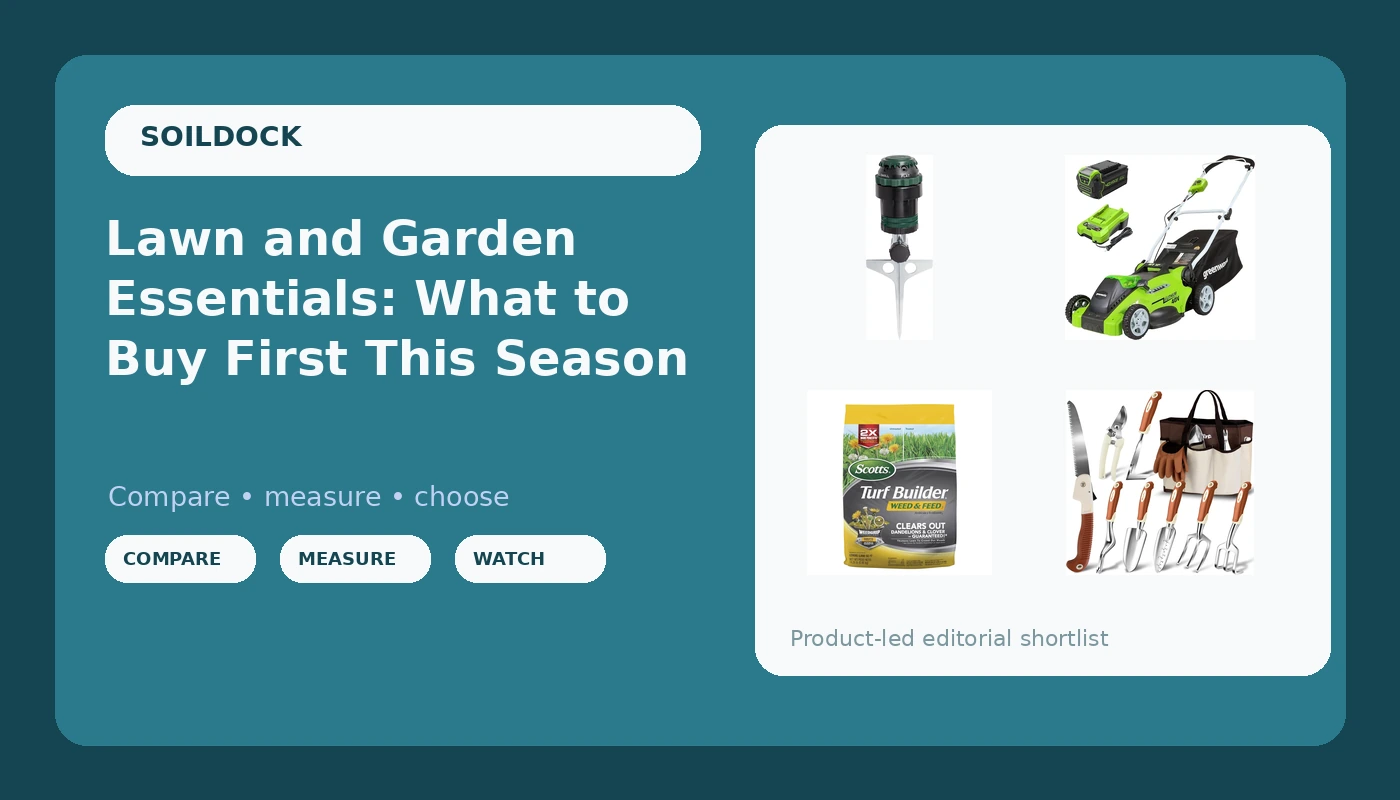
A lawn and garden season runs on four jobs, and most people buy for them in the wrong order. Someone walks into a store in April, buys whatever is stacked by the door, and then spends the rest of the year working around a gap. No way to water a slope evenly. No way to feed turf without guessing at the rate. No hand tool that stays comfortable past the first warm weekend. The lawn and garden essentials below cover the four jobs that actually decide how a yard looks in August: cutting, watering, feeding, and the endless small hand work around beds and borders. None of these are exotic picks. That is the point. A yard is a system, and a system only works when each piece does one job properly.
Related: How to Read a Soil Test Before You Feed Your Lawn →
Quick answer
Match the purchase to the job, not to the season. A cordless push mower handles routine cutting without gas or a cord. A gear-drive sprinkler on a spike handles pattern-controlled watering. A granular weed and feed handles turf feeding and listed broadleaf weeds in one pass. A basic hand tool set handles planting, weeding, and transplanting. Start with the job you are currently doing badly, buy the simplest tool that does it, and let the label and your own soil test set the schedule rather than a calendar on a store display.
Four useful options
| Model | Best fit | What stands out |
|---|---|---|
| Greenworks 40V 16in Push Lawn Mower, 4.0 Ah Battery and Charger | Routine cutting on small to mid-size lawns | 40V battery platform with a 16-inch push deck, battery and charger included |
| Orbit H2O-Six Gear-Drive Sprinkler on Metal T-Spike - Customizable Lawn Watering Coverage - Multi-Pattern Rotating Head with Adjustable Spray Range - Durable Outdoor Yard Irrigation Sprinkler - 58573 | Watering lawns and beds where you want to set the pattern | Gear-drive rotating head with multi-pattern coverage and adjustable spray range on a metal T-spike |
| Scotts Turf Builder Weed & Feed3, 14.29 lbs. | Feeding turf and controlling listed broadleaf weeds in one application | Granular weed and feed formula in a 14.29 lb bag |
| MelonArt Garden Tool Set,10 Pcs Heavy Duty Gardening Hand Tool Kit for Women Aluminum with Non Slip Ergonomic Handle, Storage Tote Bag and Gardening Gloves, Ideal Gifts for Women and Men | Planting, weeding, loosening, and transplanting by hand | Ten-piece aluminum set with non-slip ergonomic handles, a storage tote, and gloves |
The cutting job: Greenworks 40V 16in Push Lawn Mower, 4.0 Ah Battery and Charger
A mower is the tool most homeowners use more hours than anything else they own, which makes the battery platform a bigger decision than the deck width. If you already run other 40V tools, the battery you own is worth more than a spec sheet. If you do not, buy into one platform and stay there, because a second battery costs more than most people expect and a mower that shares nothing with your trimmer means two chargers on the wall. Deck size is the other honest trade-off: a 16-inch deck is easier to turn around a bed edge and easier to store, and it simply takes more passes on a wide open lawn. Measure the turf before you decide. Then set the cutting height once, at the high end of the recommended range for your grass type, and leave it there for the season. Scalping a lawn in July is the fastest way to hand the summer to weeds.
The watering job: Orbit H2O-Six Gear-Drive Sprinkler on Metal T-Spike - Customizable Lawn Watering Coverage - Multi-Pattern Rotating Head with Adjustable Spray Range - Durable Outdoor Yard Irrigation Sprinkler - 58573
Watering is where most lawns are lost, and almost never because the sprinkler was cheap. It is lost because the coverage was uneven, or because someone watered a little every evening instead of deeply twice a week. A rotary head on a spike gives you two things a fixed spray head does not: an adjustable pattern you can aim away from the driveway, and a slower application rate that lets water soak in rather than run off. The spike also matters more than it looks. A plastic base that tips over in wind or under hose tension ends up watering the same spot twice and the far corner never. Set the pattern on a dry day, watch where the water actually lands, then adjust. Put a straight-sided can or two out in the coverage area and check how much you collected. If the cans disagree by a lot, move the sprinkler, not the hose.
The feeding job: Scotts Turf Builder Weed & Feed3, 14.29 lbs.
Weed and feed is the product people misuse most, and the misuse is almost always rate and timing rather than the product itself. Three rules cover most of it. Read the label for the spreader setting and the coverage area, because guessing produces stripes of too much and too little. Apply when the turf is dry and rain is expected within the window the label allows, not before a downpour that washes granules into the gutter. And respect the temperature limits on the label, since applying in the heat of summer is a documented way to stress grass you were trying to help. A soil test from your county extension office is the cheapest input in this whole article. It tells you whether your lawn actually needs phosphorus or just nitrogen, and it costs less than most bags of fertilizer. Feed the soil test, not the calendar.
The hand work: MelonArt Garden Tool Set,10 Pcs Heavy Duty Gardening Hand Tool Kit for Women Aluminum with Non Slip Ergonomic Handle, Storage Tote Bag and Gardening Gloves, Ideal Gifts for Women and Men
Hand tools are where ergonomics stops being a marketing word and starts being the reason you finish a bed or quit halfway. A handle that is too narrow or too slick concentrates pressure in the same spot on your palm for every trowel of soil, and by the third bed that spot is telling you about it. Non-slip grips and a shaped handle spread that load, and gloves add another layer between your skin and the work. A set like this makes sense when you are starting from nothing and want the common shapes on hand, or when you are outfitting a second shed, a community plot, or a gift. What it does not do is replace a digging fork or a full-size spade for real excavation. Keep the hand tools for hand-sized jobs and they will last. Use a trowel to pry out a shrub and you will find the weak point of any small tool very quickly.
Prices and availability may change. Product images, names, and retailer links must be matched to the correct product record. Do not state a current price, rating, stock status, or measured result without current evidence.
Why the order of purchase matters more than the brand
Most yards fail on sequence, not on product quality. People buy a fertilizer before they know what their soil is short of, or buy a sprinkler before they know which corner of the lawn dries out first. The result is money spent on a problem that was never diagnosed.
Think of a lawn as four interlocking jobs. Cutting sets the height and health of the canopy. Watering determines how deep the roots go. Feeding adjusts what the soil can supply. Hand work handles everything that happens in beds, borders, and around foundations. Get the first three roughly right and the fourth becomes pleasant instead of frantic.
There is also a durability argument for buying in order. A tool bought for a job you do not have yet sits in a shed through a winter, and storage is where cheap tools quietly die. Rust, rot, and cracked plastic from a freeze-thaw cycle do more damage than most people expect. Buy the tool the week you need it, use it hard, and let a full season tell you whether it earned its spot.
Reading a label before you buy
The label on a lawn product is the only document that knows your situation. It carries the application rate, the coverage area, the spreader settings for common spreaders, the temperature and moisture conditions the manufacturer considers acceptable, and the list of weeds the product is labeled to control. None of that is optional reading, and none of it is marketing.
Two habits pay off. First, calculate the area you are treating before you buy, in square feet, so you know whether one bag covers your lawn once or twice. Second, check whether the product is a preventive or a post-emergent, because the timing window is completely different. A weed and feed applied at the wrong growth stage feeds the weeds along with the grass.
For tools, the equivalent of a label is the construction detail. Look at how the head attaches to the handle. Look at whether the handle is a solid material or a painted coating over something else. Look at whether the blade or the spring is replaceable. Those three questions predict how long a tool stays in service far better than the front of the package does.
How to plan a season in five steps
- Test the soil first. A county extension soil test tells you pH, phosphorus, potassium, and organic matter, and it costs less than most bags of fertilizer. Everything downstream depends on it.
- Measure your lawn and beds in square feet. Coverage numbers on every label and every sprinkler pattern are meaningless without your actual area.
- Fix the mowing routine before anything else. Set the deck high, keep the blade sharp, and cut often enough that you never remove more than about a third of the leaf blade at once.
- Set the watering pattern by observation, not by guesswork. Run the sprinkler, watch where the water lands, and check with straight-sided cans before you trust the coverage.
- Feed on the label's schedule and the soil test's recommendation. Then stop, and let the grass respond before you add anything else.
Practical guidance that saves money
- Buy into one battery platform and stay there. Shared batteries across mower, trimmer, and blower are worth more than any single tool's feature list.
- Write the purchase date on the tool or the bag. A dated record is how you learn what actually lasts in your conditions.
- Store hand tools dry and off the floor. Moisture plus a freeze is what cracks handles and pits steel.
- Keep the mower blade sharp. A dull blade tears grass rather than cutting it, and torn tips brown off and invite disease.
- Read the spreader setting twice. Striping a lawn with too much product in one pass is the most common self-inflicted lawn injury there is.
Which option should you choose?
Choose the Greenworks 40V 16in Push Lawn Mower, 4.0 Ah Battery and Charger when cutting is your bottleneck and you want to drop gas and cords without committing to a large deck. Choose the Orbit H2O-Six Gear-Drive Sprinkler on Metal T-Spike - Customizable Lawn Watering Coverage - Multi-Pattern Rotating Head with Adjustable Spray Range - Durable Outdoor Yard Irrigation Sprinkler - 58573 when your problem is uneven coverage and you want to aim the pattern rather than move a hose every twenty minutes. Choose the Scotts Turf Builder Weed & Feed3, 14.29 lbs. when a soil test and a weed survey say your turf needs feeding and you have listed broadleaf weeds to manage at the same time. Choose the MelonArt Garden Tool Set,10 Pcs Heavy Duty Gardening Hand Tool Kit for Women Aluminum with Non Slip Ergonomic Handle, Storage Tote Bag and Gardening Gloves, Ideal Gifts for Women and Men when you are starting from an empty shed, outfitting a second plot, or replacing a scattered pile of mismatched hand tools.
A caveat worth stating plainly: fit depends on your lawn, your soil, and your budget, and no article can measure those for you. A soil test and a tape measure will tell you more about what to buy than any product page, including this one. Treat the four items here as job categories with one example each, not as a fixed kit that suits every yard.
The bottom line
The lawn and garden essentials that matter are the ones attached to a job you are actually doing this month. A cordless push mower solves cutting. A gear-drive sprinkler on a spike solves even watering. A granular weed and feed solves feeding and listed broadleaf weeds in one pass. A ten-piece hand tool set solves the small work around beds. Buy them in the order your yard demands, read every label, test the soil before you feed it, and judge each purchase by whether it is still doing its job at the end of the season rather than how it looked on the day it arrived.