Fall lawn care has a reputation problem. Spring gets the seed bags and the weekend heroics; fall gets whatever energy is left after the tomatoes come out. For cool-season grass that order is backwards. In the weeks between the first cool nights and the first hard freeze, turf slows its top growth and pushes energy into roots, which is why a fall feeding can matter more to next April than anything you do in May.
The second problem is that fall lawn care gets sold as a single product when it is really a short sequence: feed the grass, keep water even, fill thin spots or add color, and keep your own knees out of the wet clay while you do the work. The four items below each cover one part of that sequence, and none of them substitutes for the others.
Related: How to Read a Soil Test Before You Buy Fertilizer →
Quick answer
Treat fall lawn care as a sequence, not a shopping list. Feed cool-season grass while it is still actively growing, keep irrigation even while roots are extending, seed or plant color where the lawn and beds are bare, and give your knees a dry surface during long bed work. If you add only one item this fall, add the fertilizer, because the feeding is the step that changes next spring the most. The sprinkler, the seed, and the kneeler are the pieces that make the feeding and the cleanup easier to do properly.
4 useful options
| Model | Best fit | What stands out |
|---|---|---|
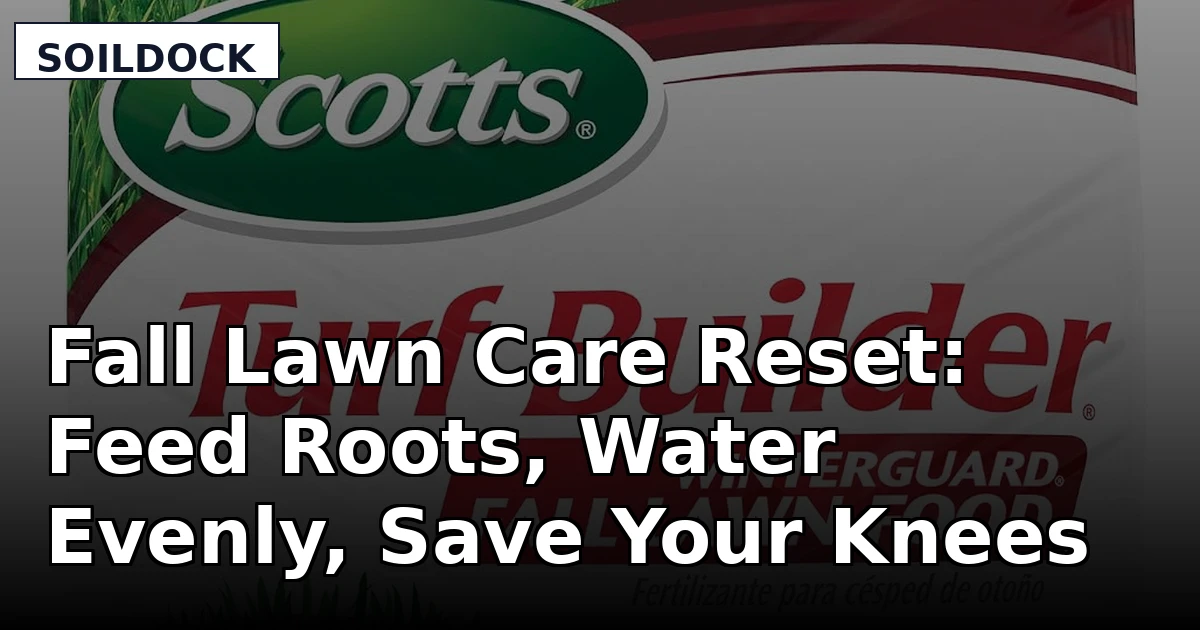
| Scotts Turf Builder WinterGuard Fall Lawn Food, 12.5 lb. | Lawns that need one fall feeding before dormancy | 12.5 lb. bag, listed coverage of 5,000 sq. ft., positioned as a fall food that builds deep grass roots for next spring |
| KVR Upgraded Garden Kneeler and Seat | Long weeding, planting, and bed cleanup sessions | Foldable stool and kneeler in one, thick and wide soft kneeling pad, two tool pouches |
| HOME GROWN Crackerjack African Marigold Seeds | Beds and borders that need annual color next season | 5,600+ seeds of Tagetes erecta, the African marigold type known as Crackerjack |
| Eden 96213 Weighted Essential Oscillating Sprinkler | Even watering over a large lawn or bed footprint | Coverage listed up to 3,600 sq. ft., 16 precision nozzles, adjustable range, turbo drive motor, stainless steel filters, quick connect bundle |
The fall feeding: Scotts Turf Builder WinterGuard Fall Lawn Food, 12.5 lb.
A fall fertilizer is a timing purchase more than a brand purchase. The label on this bag says 5,000 sq. ft., which is only useful after you have measured your actual lawn. Pace off the front, the back, and the side strips, multiply length by width, and subtract the house, driveway, and beds. If your number is 8,000 sq. ft., you need two bags, and if it is 2,000, half a bag covers you and the rest needs to stay dry.
The other half of timing is the grass itself. Fall food is meant to go down while the lawn is still green and still being mowed, when soil is cool but not cold and roots are still taking up nutrients. Feeding after top growth stops leaves nitrogen sitting in soil that nothing is drinking, and that nitrogen has somewhere to go, which is usually downhill into the storm drain. Read the bag for the spreader setting, calibrate the spreader with a measured pass, and write the date and rate in a notebook. That record is worth more next fall than any memory of what you did this year.
The kneeling station: KVR Upgraded Garden Kneeler and Seat
Fall is when the bed work stacks up: cutting back perennials, dividing, planting bulbs, hauling compost, and pulling the last of the weeds before seed heads drop. That is hours on your knees in cold, damp ground, and it is the part of the season people feel in their hips the next morning. A convertible kneeler gives you two positions, sitting for close work and kneeling with the frame as a handle to push yourself back up, which is the move that gets hard first.
Two things to check before you commit. First, the hinge and the frame, because that is where folding garden seats fail, and a frame that flexes under a 200 pound gardener is not heavy duty no matter what the listing says. Second, the pad, because a thin pad over clay is the same as no pad. If you store it outdoors, bring it in before the first hard freeze; plastic hinges and composite frames do not enjoy Ohio's freeze and thaw cycle, and a seat that cracks in January is a spring replacement.
The seed: HOME GROWN Crackerjack African Marigold Seeds, 5,600+ Seeds, Tagetes erecta
Be clear about what this is. Crackerjack African marigolds are warm season annuals, so this is not a fall sowing purchase in a place like central Ohio. Marigold seed needs warm soil to germinate, and seed dropped into cooling October ground mostly feeds the birds. What this is instead is a next season purchase you make in fall, while you are already standing in the seed aisle with the fertilizer, and a plant you plan bed space for while you are cleaning that bed out.
The 5,600 seed count is the part to think about honestly. That is a lot of marigolds, far more than most home gardens can hold at the spacing Tagetes erecta wants, which is roughly a foot apart for the tall types. Plan to share the packet, split it with a neighbor, or succession sow a few rows and let the rest wait. Store the unused seed in a sealed jar in a cool, dry place, because seed kept in a humid garage loses germination percentage quietly and you find out in May. Sow it after the last frost, or start it indoors a few weeks earlier, and use it to edge vegetable beds where the height and the color do some work.
The watering tool: Eden 96213 Weighted Essential Oscillating Sprinkler
Fall dry spells are sneaky. The air cools, the lawn stops looking stressed, and homeowners shut the water off three weeks before the grass actually stops growing. If you fed the lawn, you now have an obligation to water it, because fertilizer without moisture does nothing useful. An oscillating sprinkler is the simple answer for a rectangular lawn, and the weighted base matters more than people expect, since a sprinkler that walks itself across the yard during a cycle waters one stripe twice and the far end not at all.
Two honest caveats on that 3,600 sq. ft. figure. Coverage claims assume decent household pressure, no wind, and a sprinkler sitting level. Set out four or five straight sided cans across the pattern and run it for a timed cycle, then measure what collected. If the far cans are light, adjust the range rather than running it longer, because overwatering the near end to reach the far end is how you grow fungus. Rinse the stainless filters when you see the pattern thin out, and bring the unit inside before the first hard freeze, because trapped water and a freeze thaw cycle crack housings that were perfectly fine all summer.
Prices and availability may change. Product images, names, and retailer links must be matched by verified ASIN. Do not state a current price, rating, stock status, or measured result without current evidence.
Why fall feeding does more for next spring than spring feeding
Cool season grasses, which means Kentucky bluegrass, tall fescue, and perennial ryegrass, run on a different calendar than the warm season grasses of the South. They green up in cool weather, slow down in summer heat, and then do their most important work in autumn, when soil is still warm enough for root activity but air temperatures have dropped enough that top growth slows. Nitrogen applied in that window supports root extension and carbohydrate storage rather than a flush of blades you have to mow twice a week.
That is the mechanism behind the phrase fall lawn food. It is not marketing poetry; it is the basic physiology of a cool season plant heading into dormancy. The practical implication is a narrow window. Feed too early, in the heat of late summer, and you push top growth that stresses the plant. Feed too late, after growth has stopped, and the nutrients sit in soil with no root system actively taking them up. Soil temperature is the honest signal, and a simple soil thermometer read at a few inches deep tells you more than the calendar on the bag.
The second implication is that fall feeding is not a substitute for soil testing. Nitrogen is the nutrient grass needs in the largest quantity, but pH, phosphorus, and potassium determine whether the nitrogen you buy can actually be used. A five dollar soil test from a county extension office, or a lab test through the mail, tells you whether you are fixing a deficiency or adding to an excess. Excess phosphorus in particular does not stay in your lawn, it moves with runoff, which is a problem for everyone downstream.
How to size up your own lawn before you buy anything
- Measure the turf area in square feet. Break the yard into rectangles, multiply, and subtract hard surfaces. Every coverage number on a bag or a sprinkler listing is meaningless until you know your own square footage.
- Pull a soil test and read it before the fertilizer. Look at pH, phosphorus, and potassium, and note the recommendation rate rather than guessing at it.
- Check the grass, not the calendar. If the lawn is still green and you are still mowing, you are inside the fall feeding window. If growth has stopped, you are past it.
- Audit your water coverage with straight sided cans. Set them out, run a timed cycle, and measure. Uniformity matters more than total volume.
- Match the planting plan to the season. Warm season annuals like marigolds wait for spring; fall is for ordering, planning bed space, and clearing the ground they will go into.
Practical habits for a fall lawn care season
- Keep mowing until growth stops, and set the deck high rather than scalping the lawn short for winter.
- Water deeply and less often, in the morning, and only when rainfall has not done the job for you.
- Keep leaves off the turf. A matted layer of wet leaves smothers grass and holds moisture against the crown.
- Store fertilizer and seed dry. Both pull moisture from humid air, and clumped fertilizer spreads unevenly.
- Bring hoses, sprinklers, and folding plastic garden furniture inside before the first hard freeze, because freeze thaw cycling cracks what summer never touched.
- Log what you applied, when, and at what rate. A dated notebook entry beats a memory of last October.
Which option should you choose?
Choose the Scotts Turf Builder WinterGuard Fall Lawn Food, 12.5 lb. when your cool season lawn is thin going into winter and you want one feeding inside the fall window, sized to a 5,000 sq. ft. area. Choose the KVR Upgraded Garden Kneeler and Seat when your fall list is mostly bed work and your knees are the limiting factor. Choose the HOME GROWN Crackerjack African Marigold Seeds, 5,600+ Seeds, Tagetes erecta when you are planning next season's color and have bed space, neighbors, or a seed swap to share the packet with. Choose the Eden 96213 Weighted Essential Oscillating Sprinkler when fall rain is unreliable and you need even coverage across a large lawn.
A caveat worth repeating: coverage figures, seed counts, and feeding rates are label claims, and results depend on your soil, your pressure, your wind, and your timing. None of the four replaces a soil test, and none of them works as well alone as it does in the sequence.
The bottom line
Fall lawn care is a sequence with one anchor. The feeding comes first, because root growth in cool soil is what determines how the lawn looks next May. Water makes that feeding usable, seed and annuals are the next season's planning done early, and a kneeler is what keeps you working long enough to finish the bed cleanup before the ground locks up. Measure your square footage, test your soil, buy only the coverage you can actually use, and write down what you did. That record, not the bag, is what makes next fall easier than this one.