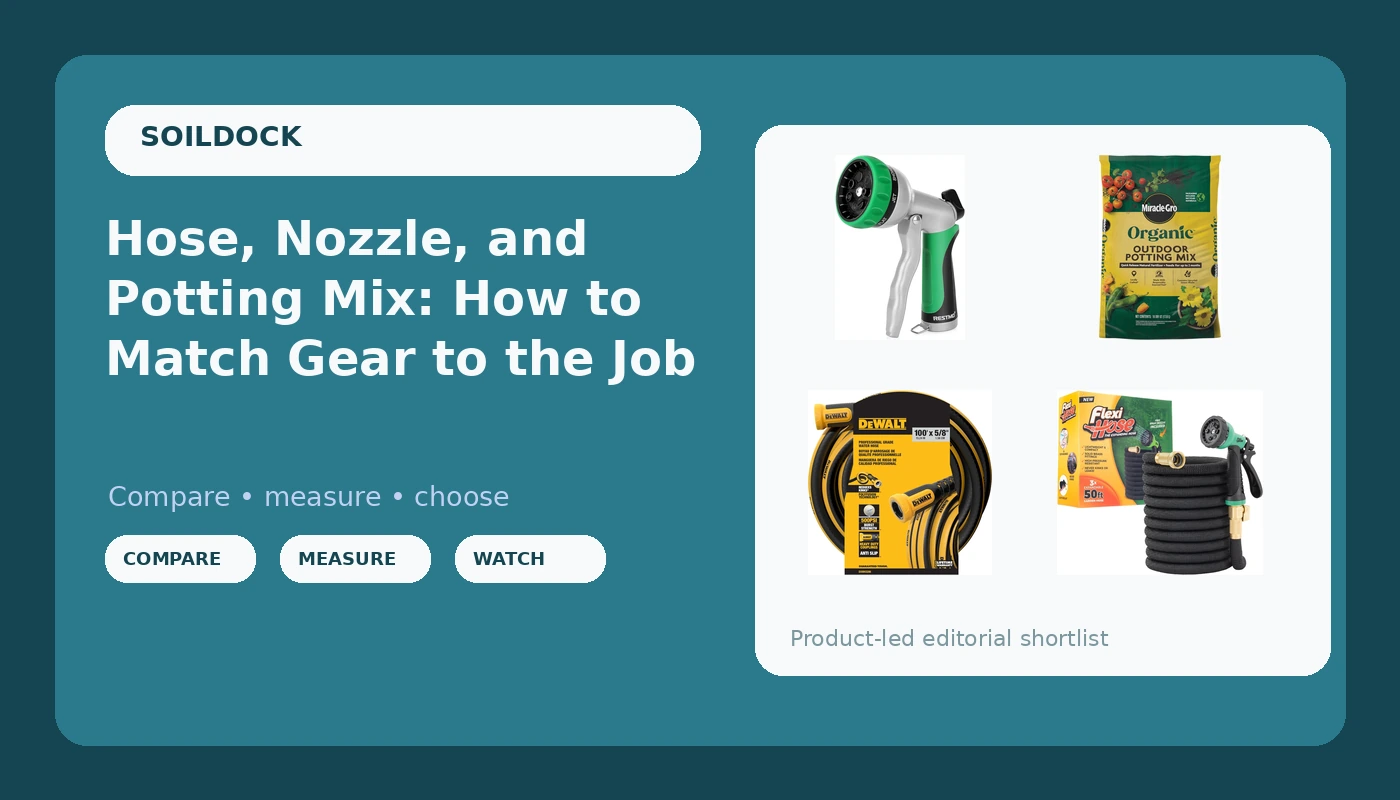
A garden hose and nozzle setup usually fails in one of three places, and the failure is almost never a mystery. The run is too long for the hose diameter. The sprayer is the wrong tool for the job it is being asked to do. Or a bagged potting mix is being asked to do work that garden soil should have been doing all along. None of that is luck. It is arithmetic you can run in your head before you spend anything.
The four items below cover the three links in that chain: a hose to carry the water, a nozzle to shape it, and a growing medium to hold it. Which one you need first depends entirely on where the problem shows up. If the sprayer dribbles at the end of a hundred-foot run, a new nozzle will not fix it, because a nozzle can only restrict flow, never add pressure. If the containers on the patio are bone dry by mid-afternoon in July, a bigger hose will not fix that either, because the problem is in the medium, not the plumbing.
Related: Hose Length, Diameter, and Water Pressure: How to Match Them →
Quick answer
Start with the run, not the sprayer. For most home yards a 5/8-inch hose is the practical default, because it moves more water per foot of length than a 1/2-inch hose, and a 50-foot hose loses less pressure to friction than a 100-foot hose of the same diameter. Match the nozzle to what the hose can actually deliver, and use a bagged potting mix for containers and raised beds rather than digging soil out of the yard. If you are watering established in-ground beds, mulch and soil structure will do more for you than any spray pattern on the market.
4 useful options
| Model | Best fit | What stands out |
|---|---|---|
| RESTMO Garden Hose Nozzle, Heavy Duty Metal Water Hose Nozzle with 7 Adjustable Spray Patterns, High Pressure Hand Sprayer with Flow Control for Watering Plants & Lawns, Washing Cars & Pets | Replacing a failed sprayer on a hose you already own | Seven adjustable spray patterns with trigger-mounted flow control |
| Miracle-Gro Organic Outdoor Potting Mix, 16 qt. | Containers, window boxes, and top-offs on raised beds | 16-quart bag sold as an organic outdoor potting mix |
| DEWALT Professional Grade Heavy Duty Garden Hose 100 Feet x 5/8 Inch | Long runs across a large yard | 100 feet long and 5/8 inch in diameter |
| Flexi Hose with 8 Function Nozzle, 50FT - Lightweight Expandable Garden Hose, No-Kink Flexibility, 3/4 Inch Solid Brass Fittings and Double Latex Core | Small yards where storage space is as tight as the beds | Expandable 50-foot hose with an 8-function nozzle and brass fittings |
The sprayer: RESTMO Garden Hose Nozzle, Heavy Duty Metal Water Hose Nozzle with 7 Adjustable Spray Patterns, High Pressure Hand Sprayer with Flow Control for Watering Plants & Lawns, Washing Cars & Pets
The nozzle is the cheapest link in the chain and the one that fails first, which is why it is also the one people replace most often. The feature worth paying attention to here is not the pattern count, it is the flow control at the trigger. In heavy clay, a full-open stream hits the surface faster than the soil can absorb it and most of that water leaves the bed as runoff. Being able to cut the flow without a trip back to the spigot is the difference between watering a bed and washing it.
Be clear about what a nozzle can and cannot do. It shapes and restricts flow. It does not create pressure, so if the hose feeding it is undersized or very long, patterns will collapse at the far end no matter how good the sprayer is. If you are watering seedlings with a stream setting, you will wash the seed out of the row. Match the pattern to the plant, and match the hose to the run.
The growing medium: Miracle-Gro Organic Outdoor Potting Mix, 16 qt.
The most common container mistake I see is not underwatering. It is filling a pot with soil dug out of the yard. Garden soil has structure built for a field, where roots spread wide and water drains down through a profile measured in feet. Put that same soil in a 12-inch pot and you have created a bucket of compacted clay with nowhere for water to go. Potting mix is manufactured for the opposite condition: high air-filled pore space, fast drainage, and enough water-holding material that a container does not dry out by lunchtime.
A 16-quart bag is about four gallons of material, and that disappears faster than most people expect. Two large planters can empty a bag. So do the math before you buy: estimate the volume of every container you intend to fill, add a little for settling, and buy accordingly. For raised beds, bagged mix is best used as a top dressing or to refresh the planting zone, not as the entire fill, because filling a four-by-eight bed with bagged product gets expensive in a hurry.
The long-run hose: DEWALT Professional Grade Heavy Duty Garden Hose 100 Feet x 5/8 Inch
Every foot of hose costs you pressure to friction, and every reduction in diameter costs you more. That is why a 100-foot hose at 5/8 inch is a very different tool from a 100-foot hose at 1/2 inch. The larger diameter is doing real work: it lowers the friction loss across the run so the nozzle at the far end still has something to shape. If your spigot is on the house and the far bed is at the back fence, this is the specification to look at first.
Two habits keep a long hose usable. Coil it rather than leaving it snaked across the lawn, because sun and traffic are what kill the outer jacket, and drain it completely before the first hard freeze. Water left in a hose through an Ohio winter expands and does damage from the inside, and a split jacket in April is a spring expense you did not plan for. A long hose is also heavy when charged, so plan the route once and leave it there rather than dragging it around the yard every time you water.
The compact setup: Flexi Hose with 8 Function Nozzle, 50FT - Lightweight Expandable Garden Hose, No-Kink Flexibility, 3/4 Inch Solid Brass Fittings and Double Latex Core
Expandable hose is a specific tool with specific rules, and most of the complaints about it come from breaking those rules. The inner core expands under pressure, so the hose wants to be drained and relaxed when it is not in use, and it does not want to be left charged and baking on a driveway all summer. It also does not want to be dragged around sharp corners or over the edge of a raised bed, because the outer sleeve protects a fairly thin core.
Used within those limits, it solves a real problem: a 50-foot hose that stores on a hook instead of eating a wall. The brass fittings matter more than they sound, because plastic threads are what strip first when a homeowner cross-threads a nozzle in April. If your lot is small, your beds are close to the spigot, and your storage is a shed corner, this is the configuration that fits. If your run is long, this is the wrong category entirely, and the 100-foot hose above is the honest answer.
Prices and availability may change. Product images, names, and retailer links must be matched by verified ASIN. Do not state a current price, rating, stock status, or measured result without current evidence.
Why hose diameter and length decide what the nozzle can do
Water leaves a spigot at whatever pressure the system delivers, and then it starts losing. Friction against the inside wall of the hose eats pressure steadily along the run, and the loss grows with length and shrinks with diameter. That is the whole reason a 1/2-inch hose feels fine at 25 feet and pathetic at 100. Elevation adds its own tax: pushing water uphill costs roughly one pound per square inch for every 2.3 feet of rise, so a bed on a slope is working against you twice.
This is why buying a nozzle to fix a weak stream usually disappoints. The nozzle is downstream of every loss in the system. It can concentrate what arrives, and it can shut flow down to a trickle so the stream stays coherent, but it cannot manufacture volume that the hose never delivered. If you are troubleshooting, work backward: spigot, then hose diameter, then hose length, then connections and washers, and only then the sprayer.
Two other details matter more than shoppers expect. First, the washer inside the female fitting is a wear item, and a torn one will spray your shirt all season while you blame the nozzle. Second, a hose stored charged and pressurized in the sun ages faster than one drained and coiled, because heat and constant pressure work on the same jacket and core.
What potting mix does that garden soil cannot
A container is a closed system with a finite volume of pore space, and roots in it need both water and air. Garden soil in a pot compacts under watering, loses its large pores, and then holds water in the small ones so tightly that roots sit in a saturated, oxygen-poor environment. That is the mechanism behind most "my plant just wilted and died" container stories, and it is not a watering-frequency problem. It is a medium problem.
Potting mix is built with air-filled porosity in mind. It drains fast, resists compaction better under repeated watering, and holds enough moisture between waterings that a container is not in crisis by noon. In the ground, the same logic applies in reverse: native soil structure, organic matter, and mulch do the work that bagged mix does in a pot, and tilling in bagged product is a poor substitute for fixing drainage and adding compost.
The practical rule is simple. Containers get potting mix. Beds get soil improvement. Buying a bag of mix to fill a raised bed entirely is possible but wasteful, and digging soil from the yard to fill a planter is the single most reliable way to kill a container planting by August.
- Measure the longest run from the spigot to the farthest plant, and write the number down.
- Check the spigot and whatever is already attached, including washers and any splitter, before blaming the sprayer.
- Decide what the nozzle must do: seedlings, established beds, car washing, pets, or all of the above.
- Estimate the total volume of every container you plan to fill, then buy potting mix by that number, not by guess.
- Plan winter storage before you buy anything, because freeze-thaw damage happens to gear that was left out.
Keeping the setup working through a season
- Drain and coil hoses before the first hard freeze, and store them out of direct sun if you can.
- Do not leave a hose pressurized for days at a time, especially an expandable one.
- Replace rubber washers at the first sign of a leak, because a cheap washer protects expensive threads.
- Store nozzles and fittings indoors over winter rather than hanging on the spigot.
- Water deeply and less often where soil allows, so roots grow down instead of sitting in the top inch.
- Route hoses around sharp bed edges rather than dragging them over the corner every time.
Which option should you choose?
Choose the RESTMO Garden Hose Nozzle, Heavy Duty Metal Water Hose Nozzle with 7 Adjustable Spray Patterns, High Pressure Hand Sprayer with Flow Control for Watering Plants & Lawns, Washing Cars & Pets when the hose you own is fine and the sprayer is the part that failed. Choose the Miracle-Gro Organic Outdoor Potting Mix, 16 qt. when you are filling containers, window boxes, or topping off raised beds and you need a medium built for a pot rather than for a field. Choose the DEWALT Professional Grade Heavy Duty Garden Hose 100 Feet x 5/8 Inch when your run is long and the pressure at the far end has been disappointing. Choose the Flexi Hose with 8 Function Nozzle, 50FT - Lightweight Expandable Garden Hose, No-Kink Flexibility, 3/4 Inch Solid Brass Fittings and Double Latex Core when the yard is small and storage, not distance, is the constraint.
A caveat worth stating plainly: this is a matching guide, not a durability verdict. I have not put these four specific units through a full season in my beds, so the guidance here is about sizing, compatibility, and where each piece belongs in the chain. Durability gets decided at hour 100 and after one winter of freeze-thaw, and that verdict belongs in the Dirt Ledger, not in a spec sheet.
The bottom line
Match the hose to the distance, the nozzle to the hose, and the medium to the container, and most watering complaints solve themselves. A 5/8-inch hose over 100 feet is the right answer for a big lot, a 50-foot expandable hose with brass fittings is the right answer for a small one, a metal sprayer with trigger flow control is the cheapest meaningful upgrade most people can make, and bagged potting mix is not optional if you are growing in pots. Buy for the job you have, drain everything before the freeze, and skip the nozzle upgrade until you have confirmed the hose is delivering what it should.