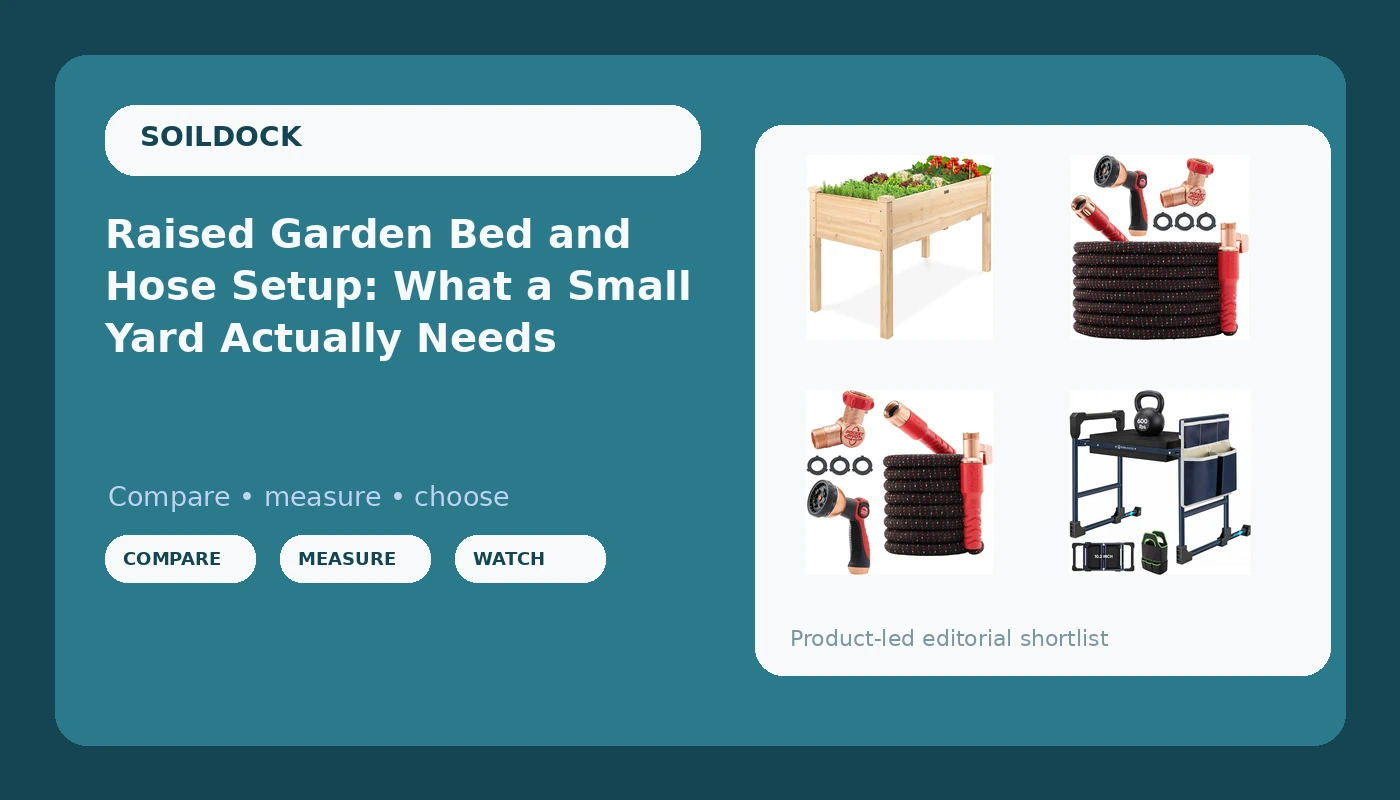
A raised garden bed and hose setup is the part of gardening nobody plans. You buy the bed, you fill it, and then you find out the watering run is forty feet short and that the kneeling which felt fine in April has become a negotiation by July. In twelve years at the extension desk I read a lot of soil sample bags, and most of the trouble homeowners brought me was not chemistry. It was layout: a bed placed where the hose cannot reach, a spigot on the wrong side of the house, ground-level work done bent over because there was no other option. The four products below cover the pieces that make a compact growing setup function without a remodel, and each one is here for a reason tied to its dimensions and construction rather than to a badge on the box.
Related: Garden Hose Length: How to Measure the Run Before You Buy →
Quick answer
Match the piece to the constraint. An elevated 48 by 24 by 30 inch wood planter with an included liner moves the planting surface off the ground and carries a 200 pound capacity rating, which suits a patio, balcony, or small yard. An expandable hose handles storage and kinking, and the length you need is decided by the distance from your spigot to the farthest bed, not by the size of your property. A folding kneeler and seat covers the ground-level planting, weeding, and harvesting that no raised bed eliminates. Each of these answers a different problem, so none of them is a universal pick.
Four useful options
| Model | Best fit | What stands out |
|---|---|---|
| Best Choice Products 48 x 24 x 30 Inches Raised Garden Bed | Patios, balconies, and small yards where bending is the limiting factor | Elevated stand, included bed liner, 200 pound capacity rating |
| Pocket Hose Ballistic 100 FT Expandable Garden Hose | Long runs to a far bed or a spigot on the opposite side of the house | 100 foot expandable length with a no-kink design |
| Pocket Hose Ballistic 50 FT Expandable Garden Hose | Compact yards, balconies, and short runs | 50 foot expandable length, same no-kink construction |
| Garden Kneeler and Seat, Heavy Duty Foldable w/Soft Kneeling Pad | Ground-level planting, weeding, and harvest work | Folds flat, soft kneeling pad, converts between kneeler and seat |
The elevated bed: Best Choice Products 48 x 24 x 30 Inches Raised Garden Bed
The trade-off here is volume. A bed this size holds a compact crop list, not a full kitchen garden: herbs, lettuce, a determinate tomato or two, peppers, maybe strawberries. The 200 pound capacity rating is a fill-weight consideration, which means it is worth thinking about what you put in it before you dump bags of wet topsoil into a stand-mounted box. The liner is the other thing to notice. On a wooden planter, a liner is what keeps saturated soil from sitting directly against the wood through a wet fall and a freeze-thaw winter, which is exactly the kind of detail that separates a bed that lasts from one that sags by the second season.
The long run: Pocket Hose Ballistic 100 FT Expandable Garden Hose
Length is the whole point of this one, and length is also where people overspend. A hundred feet is a lot of hose, and every extra foot is water that has to travel and pressure that has to carry it. If your farthest bed is thirty feet from the spigot, this is more hose than the job requires. Buy it when the measured path, plus slack for going around a corner or over a walkway, genuinely lands in that range. Expandable hoses also ask something of you in return: they want the water shut off and the line drained before they contract, and they want to be stored out of the sun rather than left coiled against a wall from March to November.
The short run: Pocket Hose Ballistic 50 FT Expandable Garden Hose
Choosing between the two lengths is not a quality question. It is a measurement question, and getting it wrong in either direction costs you. Too short and you are hauling watering cans to finish the job, which defeats the purpose of owning a hose. Too long and you are dragging excess hose across the beds you just planted, and you are asking the spigot to push water farther than it needs to. The practical approach is to walk the path with a tape measure, add a few feet for slack, and buy the shorter of the two options that clears the distance. If you are within a few feet of the boundary, the longer hose gives you room to move a bed later without buying again.
The ground-level seat: Garden Kneeler and Seat, Heavy Duty Foldable w/Soft Kneeling Pad
A raised bed reduces bending, it does not eliminate it. In-ground borders, foundation plantings, the compost pile, and the turf edge all still put you on your knees or on your heels. That is the case for a convertible kneeler rather than a plain pad: the seat position is what you want for pruning low shrubs and for anything where your hands need to be above your waist, and the kneeling position is what you want when you are setting transplants or hand-weeding a bed edge. The folding frame matters for storage, and the pad matters more than the frame. A thin pad on a hard frame is a tool you stop using by June.
Prices and availability may change. Product images, names, and retailer links must be matched by verified ASIN. Do not state a current price, rating, stock status, or measured result without current evidence.
Measure the run before you buy the hose
The single most common purchasing error in a small garden is buying a hose by yard size instead of by run length. A quarter acre and a quarter acre can need completely different hoses depending on where the spigot was placed when the house was built. Walk the actual path the hose will take, including around the corner of the house, over a walkway, and between beds. Then add slack. A hose pulled taut around a corner is a hose that kinks at that corner and a hose that wears against whatever it is rubbing on, whether that is brick, a downspout, or the edge of a raised bed.
Then think about pressure, because length costs pressure. Water has to overcome friction against the inside wall of the hose over its entire run, so a hundred feet of hose delivers less at the far end than fifty feet does from the same spigot. This is not a reason to avoid long hoses; it is a reason to avoid buying a long hose you do not need. If your beds are close, the shorter option is not a compromise, it is the correct match.
Storage is the third variable, and it is where expandable hoses live or die. An expandable hose that is left charged with water and exposed to sun and freeze-thaw cycling is being asked to do something it was not designed to do. Drain it, coil it, and put it inside or under cover before the first hard freeze. That single habit does more for hose lifespan than any feature on the label.
Height, bending, and the work that stays low
Thirty inches is the number worth dwelling on with an elevated planter. It is high enough that you are not folding yourself in half to reach the soil, and low enough that you can still reach the far side of a 24 inch deep box without a step. That combination is why the elevated format works on a balcony or a patio where an in-ground bed is not an option at all, and it is why the footprint matters as much as the height. A four foot long, two foot deep box fits along a railing, a garage wall, or the edge of a deck.
What an elevated bed cannot do is change the fact that soil is heavy when it is wet. The 200 pound capacity rating on this planter is a real constraint on how you fill it. Wet topsoil, compost, and a mature pepper plant add up fast, and a stand-mounted box that is overloaded is a box that will tell you about it. Consider a lighter soil mix, keep heavy pots out of the corners, and put the tallest, heaviest crop in the center of the frame rather than on the overhang.
The last thing to accept is that a raised bed changes the ergonomics of gardening rather than removing them. You will still kneel for the in-ground beds, still crouch to pull the turf edge, still bend to turn the compost. Plan for the ground-level work with the same seriousness you plan for the beds, because that is the work that decides whether you are still gardening in September.
- Measure the path from spigot to the farthest bed, including corners and crossings.
- Add slack, then buy the shorter hose length that clears the measured distance.
- Check the planter's working height and depth against your own reach before you commit.
- Confirm what the bed is rated to hold, and fill it with a mix that respects that rating.
- Decide where ground-level work will happen, and give yourself a seat or a pad for it.
- Plan winter storage now: drain the hose, cover or move the planter's soil, store the pad dry.
Setting up a small garden without regrets
- Buy the hose by measured run length, not by the size of the property.
- Put the bed where the water already reaches, rather than extending the hose to reach the bed.
- Read capacity ratings as limits, not suggestions, especially on elevated planters.
- Use the included bed liner as intended; it is what separates wet soil from wood.
- Drain and store the expandable hose before the first hard freeze, every season.
- Keep a kneeler or seat near the beds you work most, or you will work around it.
Which option should you choose?
Choose the Best Choice Products 48 x 24 x 30 Inches Raised Garden Bed when you are growing on a patio, balcony, or narrow strip and want the planting surface off the ground with a liner already in place. Choose the Pocket Hose Ballistic 100 FT Expandable Garden Hose when your measured run to the farthest bed is genuinely long, or when the spigot sits on the opposite side of the house from the garden. Choose the Pocket Hose Ballistic 50 FT Expandable Garden Hose when the beds are close to the spigot and a compact, easily stored hose matches the actual distance. Choose the Garden Kneeler and Seat, Heavy Duty Foldable w/Soft Kneeling Pad when in-ground beds, borders, or compost work still put you on the ground and you want one piece that serves both kneeling and sitting.
A caveat on all four: the specs in this article come from the product listings, not from a season of use in my own beds. Treat dimensions, capacity ratings, and construction details as the starting point for your decision, and treat any claim about how a tool performs at hour 100 as something you should verify against your own soil, your own climate, and your own storage habits.
The bottom line
These four pieces solve four different problems, and the order you buy them in should follow the problem that is actually stopping you. If bending is the barrier, start with the elevated planter. If you are carrying cans because the hose will not reach, measure the run and buy the matching length. If the work that remains at ground level is what you dread, get the seat. What ties them together is that each one is a measurement decision before it is a brand decision: height, run length, capacity, and reach. Get those four numbers right and the setup stops fighting you, which is the only outcome that matters over a full season.